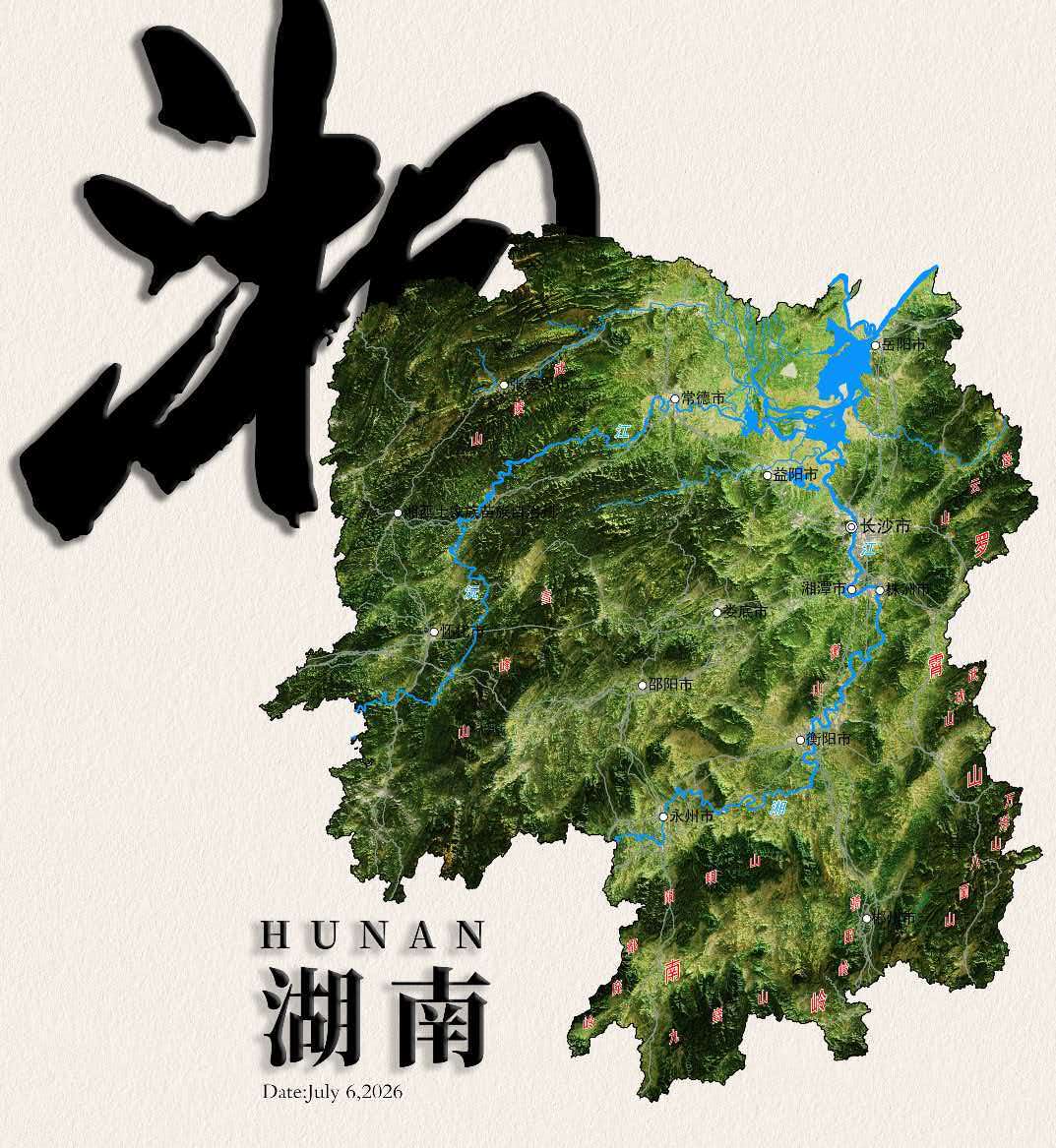
Hunan, abbreviated as "Xiang," was historically known as Xiaoxiang and Sanxiang Sishui. Its capital is Changsha, located in central China on the southern bank of the middle reaches of the Yangtze River. The province derives its name from the fact that most of its territory lies south of Dongting Lake. Covering a total area of 211,800 square kilometers, Hunan administers 13 prefecture-level cities and one autonomous prefecture. The landscape is predominantly composed of mountains and hills, with diverse topographical features including ridges, plains, and water bodies. The Xuefeng Mountains run through the entire province, dividing it into two major geographical regions—east and west—with rich terrain layers and varied landforms. The climate is subtropical and humid monsoonal, characterized by distinct seasons, concurrent heat and rainfall, abundant precipitation, mild temperatures, ample sunshine, and a long frost-free period. With excellent ecological conditions, Hunan has long been praised as the "Land of Lotus."
With a profound historical heritage and a cultural lineage stretching over a thousand years, Hunan is one of the key cradles of Chinese civilization. Its history dates back to ancient times, marked by a continuous flow of cultural excellence and outstanding talents. The region boasts thousands of years of accumulated civilization and a long-standing regional development history. As a red revolutionary stronghold and cradle of revolution, Hunan carries a deep red culture and revolutionary legacy, serving as a crucial birthplace of modern Chinese revolution. The province is rich in cultural relics, with numerous protected sites at various levels. It is home to world-class and national heritage sites such as Yueyang Tower and the Laojia City ruins—the latter being a UNESCO World Heritage Site. Numerous historical landmarks, intangible cultural heritages, and ancient architectural remains have been preserved, making Hunan a culturally rich province with both profound humanistic depth and strong revolutionary roots.
Geographically strategic, Hunan enjoys excellent transportation connectivity and serves as a vital comprehensive transportation hub in central China. In aviation, it operates multiple civil airports, including Changsha Huanghua International Airport, offering flights to major domestic and international cities. The railway network is dense, with high-speed rail covering the entire province and connecting nationwide, supported by several large-scale hub stations that efficiently link to national high-speed rail lines. The highway and expressway system is extensive and well-connected, while inland waterways via the Yangtze River, Dongting Lake, and the Xiangjiang River system provide access to coastal areas. Meanwhile, urban rail transit continues to expand steadily, forming an increasingly integrated multi-modal transportation system. Hunan thus functions as a national comprehensive transportation hub linking east and west and connecting north and south.
In 2024, Hunan's GDP reached 5.3231 trillion yuan, growing 4.8% year-on-year. By 2025, the provincial GDP had steadily increased to 5.53087 trillion yuan, maintaining a steady growth trajectory. Engineering machinery, rail transit, aerospace, and new materials are the four pillar industries of Hunan, forming the core foundation of its industrial economy. At the same time, Hunan is striving to become a national advanced manufacturing center, a hub for scientific innovation, and a leader in reform and opening-up in inland China. It is a major base for advanced manufacturing and a core zone for rail transit industry clusters. Digital economy, modern agriculture, and modern business services are developing synergistically, creating a robust and diversified industrial system with strong momentum, resilience, and enormous potential for future growth.





 18801392970